From Symbols to Shared Meaning: Why Public Art Needs More Than Heritage Motifs
Public art often begins with a familiar visual language.
A mural may feature Arabic calligraphy, native plants, traditional architecture, historic occupations or patterns inspired by regional crafts. These elements help connect contemporary artwork with the cultural identity of a place.
But how do we know whether the people encountering the artwork understand its meaning?
This is becoming an increasingly important question for public art in the UAE and across the Gulf. As cities commission more murals, sculptures and artistic interventions, attention is expanding from the appearance of the artwork to the experience it creates.
The opportunity is not simply to represent heritage more frequently. It is to explore how artists can interpret cultural knowledge in ways that remain meaningful to the people using public spaces today.
Cultural identity is more than visual recognition
A new study published by researchers at United Arab Emirates University examines relationships between public art, urban design, digital engagement and perceptions of national identity.
The study reports that respondents generally viewed public art and culturally meaningful design favourably. Arabic calligraphy and natural motifs emerged as important cultural references.
These findings are useful, but they require careful interpretation.
The research examines reported perceptions. It does not establish that installing a mural independently increases cultural belonging, nor does it tell us how individual artworks are understood by the people passing them every day.
That distinction matters.
A person might recognise a traditional symbol without knowing its history. Another might understand its history but disagree with how it has been represented. A younger visitor might associate the same image with something entirely different from an older resident.
An artwork's cultural meaning therefore cannot always be determined from the artist's intention alone.
From representation to interpretation
Consider an artwork inspired by Sadu weaving.
One approach is to reproduce a recognisable pattern at a larger scale. Another is to explore the weaving process, the knowledge associated with it, the people who preserve the practice and how its visual language can be reinterpreted through contemporary materials.
Both approaches might produce compelling artworks, but they communicate differently.
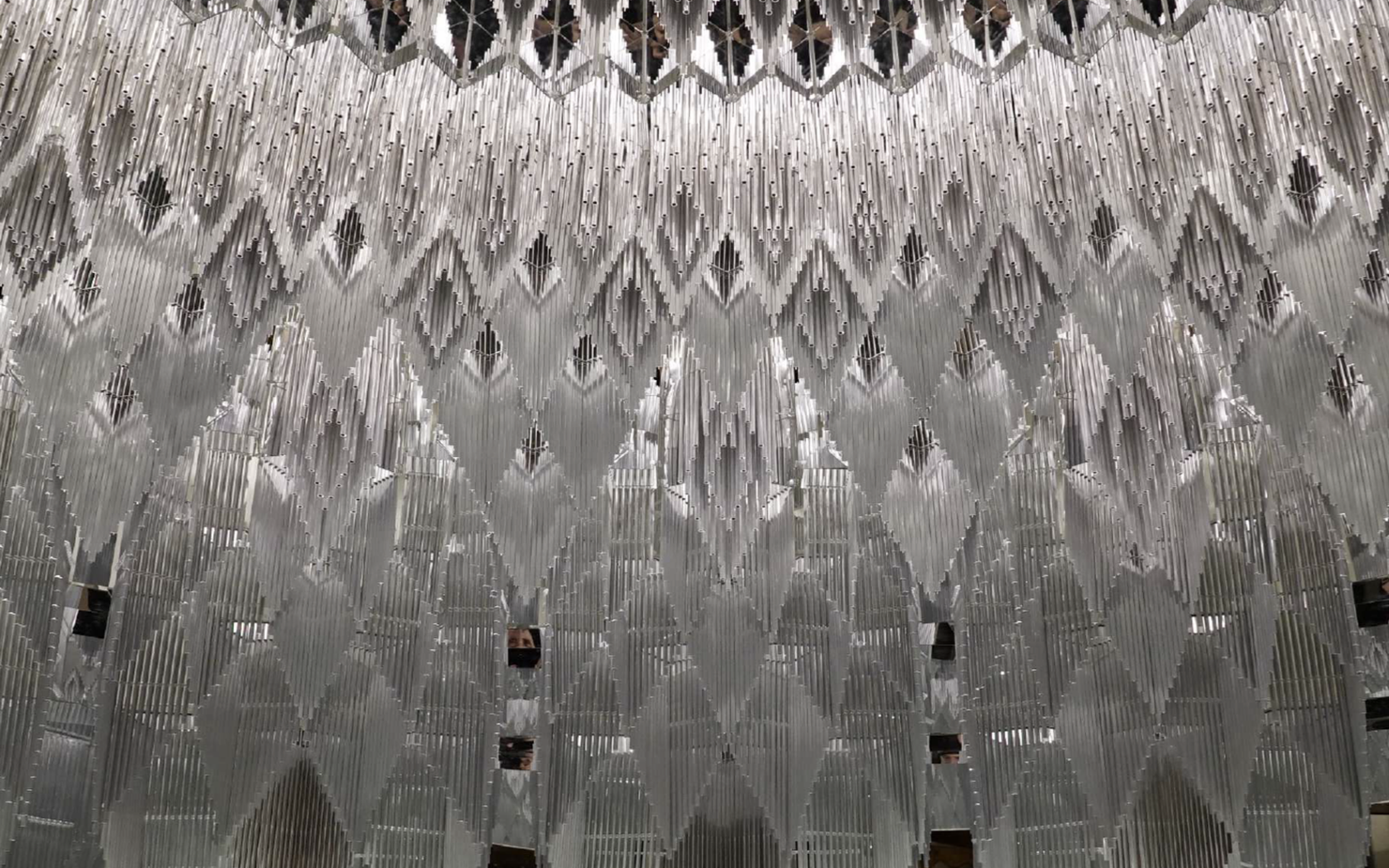
Qatar Museums' forthcoming installation The Muqarnas of Sadu, by Ghadeer Mohammad, offers an interesting example of the second approach. The project brings together the geometry of Muqarnas architecture and the visual language of Sadu weaving. Qatar Museums lists the forthcoming Doha exhibition for 5 November 2026 to 31 January 2027.
Its significance as a practice reference lies in the translation between forms of cultural knowledge. That does not mean its public impact has already been measured.
For artists interested in cultural heritage, the lesson is to begin by researching the meaning and context of an element before deciding how it should appear.
The city is part of the artwork
Public art does not exist independently of the place around it.
A mural on a busy road is encountered differently from an artwork in a shaded residential park. A sculpture in a civic plaza may become a landmark, while an intervention along a pedestrian connection might be noticed only by people using that route regularly.
A useful commissioning question is whether people have the context and opportunity to interpret what they encounter, rather than simply recognise a familiar feature.
For Abu Dhabi, this means public-art planning should consider how people actually experience a location.
Is the artwork encountered while walking or driving? Can visitors comfortably stop? Is there shade? Will people see it during the day, after sunset or only during a particular season?
The answers can shape the artwork's scale, material, narrative and the form of interpretation that accompanies it.
They can also determine whether an apparently engaging artistic concept is suitable for the proposed location.
Who gets to understand public art?
Cultural accessibility is another important part of the conversation.
Public art occupies shared space. Its audience may include Emirati residents, people from different cultural backgrounds, children, older adults, tourists and people with disabilities.
Not everyone will interpret an artwork through the same cultural references or encounter it through the same physical and sensory abilities.
An exploratory March 2026 research preprint involving blind and low-vision participants highlights the importance of multisensory access, accurate cultural descriptions and safe navigation.
This suggests an opportunity for artists and commissioning organisations to think beyond conventional explanatory plaques.
An accessible interpretation might include concise multilingual information, artist-led audio storytelling or another format developed in consultation with the intended audience.
The technology should support the artwork's meaning rather than distract from it.
What international practice can teach us
Around the world, public-art programmes are experimenting with different ways to connect artists, places and audiences.
Bogotá’s cultural authority announced a 2026 urban-art circuit combining murals, workshops and activities across different districts. Sydney’s Art & About banner brief asks artists to respond to Oxford Street’s communities, culture, history and character. Its application period is closed; the announced display period is 12–25 October 2026.
These examples highlight different parts of the commissioning process.
One emphasises distributed participation and programming. The other places community relevance within artist-selection criteria.
Neither approach automatically guarantees a stronger sense of belonging. Their value as references lies in how the relationship between artwork, place and audience is considered before and during implementation.
For cities in the GCC, this opens possibilities beyond commissioning a series of visually related murals.
A neighbourhood programme might include cultural research, artist engagement, workshops, interpretation and follow-up observation. A temporary artwork could test an idea before a permanent investment. An established public-art collection could be supported by accessible storytelling and educational programming.
An exercise for emerging public artists
Before developing your next mural or public-art proposal, choose one visual element associated with the place.
It might be a local plant, a craft tradition, a historical practice, an architectural feature or an everyday community activity.
Research its meaning and identify the people who have direct knowledge of it.
Then create three short explanations of your concept: one for someone familiar with the tradition, one for someone encountering it for the first time, and one for a younger audience.
Ask a few willing people what they understand from your proposed visual language. Record their responses and identify where your intention differs from their interpretation.
Use the exercise to refine your concept.
This is not a validated public-art impact study. It is a practical way to strengthen cultural research and develop a more thoughtful artistic brief.
Toward a more meaningful public-art practice
As public art becomes increasingly integrated into urban development, there is an opportunity to build stronger relationships between cultural knowledge, artistic expression and the everyday experience of place.
For artists, this means researching beyond the image.
For cultural organisations, it means creating opportunities for interpretation, learning and participation.
For municipalities and developers, it means asking not only what an artwork will look like, but who it is for, why it belongs at a particular location and how its public value might be understood over time.
The goal is not to turn every mural into an academic study.
It is to make artistic decisions more informed, public-art programmes more responsive and cultural storytelling more meaningful.
DezArt connects research, artist engagement, production and implementation through its public-art and creative placemaking services in the UAE.
We welcome conversations with artists, cultural organisations and public-realm partners interested in developing site-responsive public-art projects and thoughtful approaches to community engagement.
Sources
- UAE cultural identity study / دراسة الهوية الثقافية في الإمارات
- Qatar Museums: Muqarnas of Sadu / متاحف قطر: مقرنصات السدو
- Unseen City Canvases: research preprint / بحث أولي عن إتاحة الفن الحضري
- Bogotá: urban-art circuit / بوغوتا: برنامج الفن الحضري
- City of Sydney: Art & About banner brief / سيدني: دعوة لافتات الشوارع
Image credit
Muqarnas of Sadu, Ghadeer Mohammad. Image source: Qatar Museums.